Liquid Gold: Why Africa's Next Great Export Might Be Wine, Not Gold

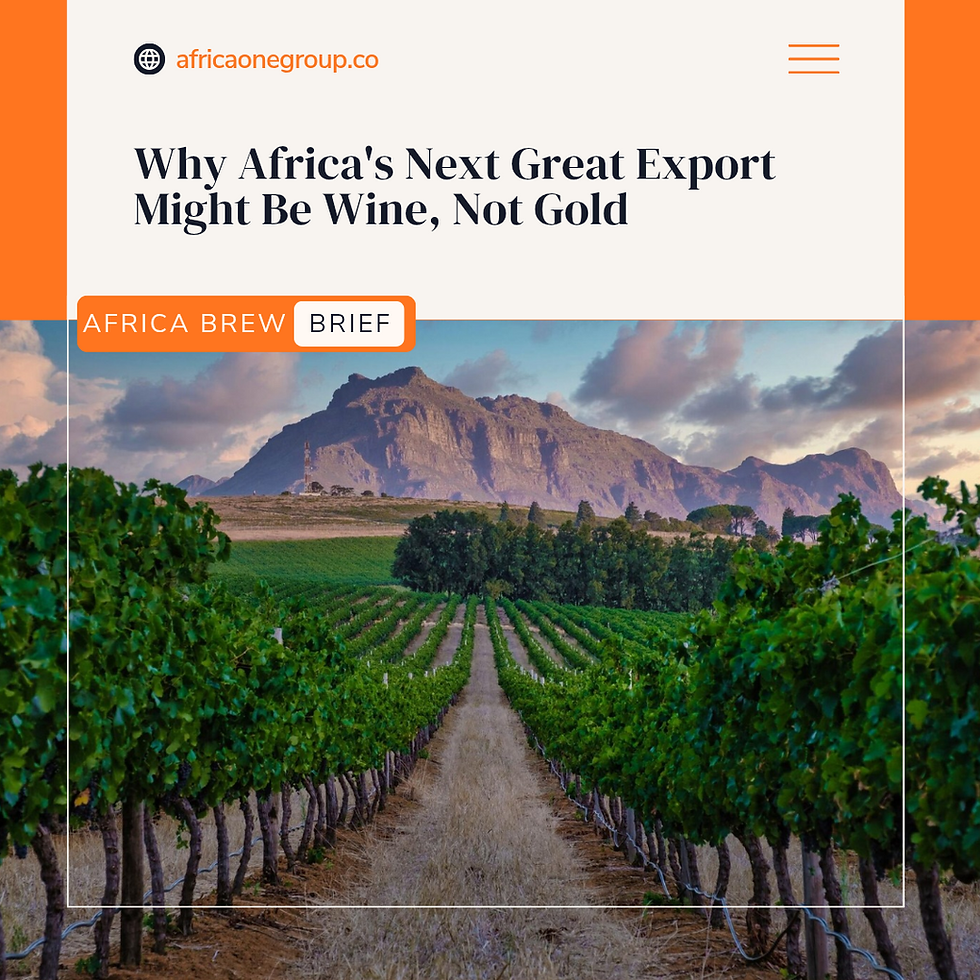
An Africa Brew Brief Investigation into the Continent's Emerging Vineyard Economy
For three centuries, the story of African wine began and ended in one place: the Cape. But that story is changing. From volcanic highlands in Ethiopia to the Rift Valley escarpments of Kenya, from the Roman-era terroirs of Meknès to the river valleys of Zimbabwe, a new generation of vintners is betting that Africa's next global export isn't a mineral — it's a bottle.
Here's what it actually takes to plant that bet.
## The Global Backdrop: A Market Worth Chasing
The global wine market is valued anywhere between roughly $490 billion and $620 billion depending on the research house, and most forecasters agree it's headed toward $800 billion–$1.3 trillion by the early-to-mid 2030s, growing at a compound annual rate of roughly 4–10% depending on the model used. Europe still dominates, holding somewhere between 44% and 60% of global revenue share, but that dominance is precisely why smart capital is looking elsewhere — established regions are mature and saturated, while frontier regions are cheap and unclaimed.
Africa's opening is structural, not sentimental. The African Development Bank projects the continent will be the world's second-fastest-growing region economically, with real GDP growth around 4.3% annually — and in several countries, far higher. Africa's population has already crossed 1.4 billion, with a rapidly expanding middle class. That combination — income growth plus population scale — is the exact engine that has historically built new wine-consuming markets from nothing.
## Where to Plant: Africa's Emerging Wine Geography
**South Africa remains the anchor, but it's a mature, not a frontier, play.** South Africa is home to six established wine regions, concentrated mostly in the Western Cape, with a 2026 grape harvest estimated at 1.37 million tons and a national vineyard footprint holding fairly steady at roughly 85,525 hectares. It's a market of scale and infrastructure — but also of pressure: vineyard area shrank about 12% between 2014 and 2023, only 8% of producers were profitable by 2023, and roughly 43% were operating at a loss, with nearly a third of grape growers exiting the industry over that period. Translation: South Africa is a market for buying distressed, established assets or partnering with existing estates — not a greenfield land grab.
**Ethiopia is the continent's most talked-about frontier.** Ethiopian vineyards sit at altitudes of 1,600–2,000 metres, benefiting from cool nights, volcanic soils, and naturally low pest pressure — conditions comparable to some of the world's top wine regions. Industry watchers now describe Ethiopia as positioned to become Africa's second major wine exporter, complementing rather than just competing with South Africa, backed by groups like Castel Group's local operations.
**Morocco is Africa's quiet second producer.** The Meknès region, 120km from Rabat, is Morocco's wine capital — fertile land, mild temperatures, long sunshine hours, with winemaking roots tracing to Phoenician and Roman-era Volubilis. Today Morocco produces around 30 million bottles a year and ranks as the continent's second-largest wine exporter after South Africa, with 14 officially recognised AOC appellations.
**Kenya, Zimbabwe, Namibia, Tunisia** round out the watch-list. Kenya's Naivasha, the Yatta Plateau, and the Great Rift Valley escarpments have emerged as viable wine-producing zones thanks to favourable climate, volcanic soil, and agri-tech advances, while Namibia and Zimbabwe are cultivating smaller but growing wine cultures, and Morocco and Tunisia continue supplying niche European markets. Tunisia's output stays largely domestic given smaller vineyard scale, but its Mediterranean-spiced, fruit-forward style has a loyal following.
**The investment thesis by region:**
- **South Africa** → acquisition/turnaround of distressed premium assets, export infrastructure already built
- **Ethiopia** → greenfield, high-altitude terroir plays, first-mover advantage
- **Morocco** → boutique/artisanal branding riding an existing AOC framework
- **Kenya, Zimbabwe, Namibia** → early-stage boutique wineries tied to tourism and domestic premiumisation
## What It Actually Costs
This is where romance meets spreadsheet. Vineyard land acquisition alone can run up to $100,000 per hectare, though costs vary enormously by geography — vineyard-ready land has ranged from roughly $13,750 per acre in lower-cost regions to over $375,000 per acre in premium appellations. On the establishment side, industry benchmarks put planting costs at around £40,000 per hectare to plant and a further £25,000 per hectare to reach first cropping, typically by year three, then roughly £12,000 per hectare annually thereafter for upkeep.
For a mid-sized commercial project: a 20-acre vineyard can require $275,000 to $7.5 million just for land, plus another $318,000 to $917,000 to plant and establish it — and that's before a winery building, tanks, or a tasting room exist. Broader industry guidance for wine-grape farming pegs total startup costs at $30,000 to over $100,000 per acre, with a 10–20 acre commercial vineyard requiring $500,000 to $2 million or more in total initial investment.
**African cost advantage:** this is precisely why Africa's frontier regions matter to investors. Africa's emerging wine regions carry significantly lower land and startup costs than Europe, aligning with global wine trends while offering scalable investment models. The same capital that buys a marginal hectare in Bordeaux or Napa can secure a meaningfully larger footprint in the Rift Valley or the Ethiopian highlands.
## How Long Until You See Your Money Back
Be honest with yourself here: **vineyards are not a fast-money asset class.**
- Time to first revenue is typically 3 years to first harvest, followed by another 1–2 years of winemaking and aging before the first bottle actually sells.
- A realistic plan assumes roughly three years before a meaningful crop, four to six years before stable production, and a base-case payback that often stretches beyond a decade.
- The nature of vineyard investing is defined by large upfront costs and relatively long payback periods — which by definition creates a cash-flow "problem" that must be underwritten from day one, not discovered later.
- Cumulative cash flow commonly stays negative for a decade or more once land and establishment costs are fully accounted for.
- Once mature, a well-managed vineyard's ROI is typically assessed over a 10–20 year horizon, with 5–15% annual returns after establishment being considered reasonable.
**Bottom line for investors:** treat a vineyard as a 10–15 year patient-capital asset, not a 3-year exit play. Anyone pitching faster returns is either leasing land to someone else's operation, doing custom-crush/contract winemaking (buying grapes, not growing them), or not telling you the full story.
## The Markets: Who's Actually Buying
**Inside Africa:** the domestic story is arguably more important than export for new entrants. Around 60% of South African wine is consumed domestically, even as exports reach over 120 countries — proof that a strong home market can carry a wine brand even without immediate global reach. The Middle East and Africa wine market is expanding on the back of urbanization, a growing expatriate population, and rising interest in gourmet and hospitality culture, with Ethiopia's rise specifically tied to a growing, youthful middle class boosting domestic demand, alongside tourism drawing travelers to vineyard experiences.
**Globally:** South Africa alone exports to more than 120 countries, and exported 306.1 million litres of wine in 2024, generating US$562 million in export value — a 4% year-on-year increase despite a contracting global market. The premiumisation trend is the key opportunity: buyers globally are shifting toward story-driven, terroir-specific, sustainably produced wine — exactly the positioning an African-origin bottle can claim that a mass-market European brand cannot.
## The Real Challenges
Africa Brew Brief doesn't sugarcoat this section:
1. **Capital intensity with delayed payback** — as shown above, this is not a business for investors needing liquidity in under 5 years.
2. **Climate volatility** — South Africa's 2026 season was described as a "pendulum season," swinging between dry stretches and heavy rainfall, which increased both irrigation costs and disease pressure.
3. **Global oversupply and pricing pressure** — even established producers flag global oversupply and pricing pressure as the central challenge, requiring disciplined supply management rather than discounting.
4. **Immature infrastructure in frontier markets** — cold-chain logistics, cellar equipment, skilled oenology labour, and export certification all have to be built from near-zero in Ethiopia, Kenya, or Zimbabwe, unlike in the Cape.
5. **Regulatory and appellation frameworks still forming** — outside North Africa's French-modeled appellation systems, most Sub-Saharan wine-producing countries, including Ethiopia and Tanzania, still have formal classification systems in their nascent stages, which can complicate export credibility and pricing power.
6. **Land cost volatility** — vineyard land pricing is not linear or predictable; it moves with speculation, currency, and proximity to any single high-profile brand's success.
## Funding Models That Actually Work
Given the payback timeline, the capital stack matters as much as the vineyard site itself:
- **Patient private equity / family office capital** — the natural fit, given 10–15 year hold periods and the asset-backed nature of land and vines.
- **Blended finance / development finance institutions (DFIs)** — well suited to frontier markets like Ethiopia and Kenya, where agri-development mandates align with vineyard establishment, especially when paired with rural employment and export-earnings narratives.
- **Custom-crush and alternating proprietorship models** — letting an existing winery carry the production capital risk while a new entrant tests market demand before committing to land, buildings, or a full vineyard payback cycle — the lowest-capital entry point, and arguably the smartest first move for anyone testing an African wine brand before planting a single vine.
- **Land-lease structures** — leasing preserves initial capital for operations and hiring rather than locking it into land ownership, though it commits the operator to high recurring lease costs.
- **Tourism-linked revenue blending** — pairing the vineyard with hospitality (tasting rooms, agritourism, estate stays) to generate cash flow *during* the pre-bearing years rather than waiting on grapes alone — a model with obvious synergy for operators already active in African hospitality.
## The Africa Brew Brief Verdict
Wine in Africa is not a quick win — it's a land, climate, and brand-building play measured in decades, not quarters. But the fundamentals are real: cheaper land than Europe, underexploited terroir in Ethiopia and Kenya, an established and recovering anchor market in South Africa, a domestic middle class that's growing faster than almost anywhere else on earth, and a global market still willing to pay a premium for a genuinely new origin story.
The investors who win this decade won't be the ones chasing the fastest exit. They'll be the ones who treated a vineyard the way it actually behaves — as patient capital planted in African soil, built to mature slowly, and built to last.
**Africa Brew Brief — Brewing the Business Behind Africa's Bottles.**


Comments